
The Future of Port Automation and Crane Cable Design
How does port automation impact crane cable design? Discover the role of hybrid fiber-optic cables from a top crane cable solution provider.
CRANE & HOIST CABLESCABLE BUYING GUIDES
5/21/20262 min read
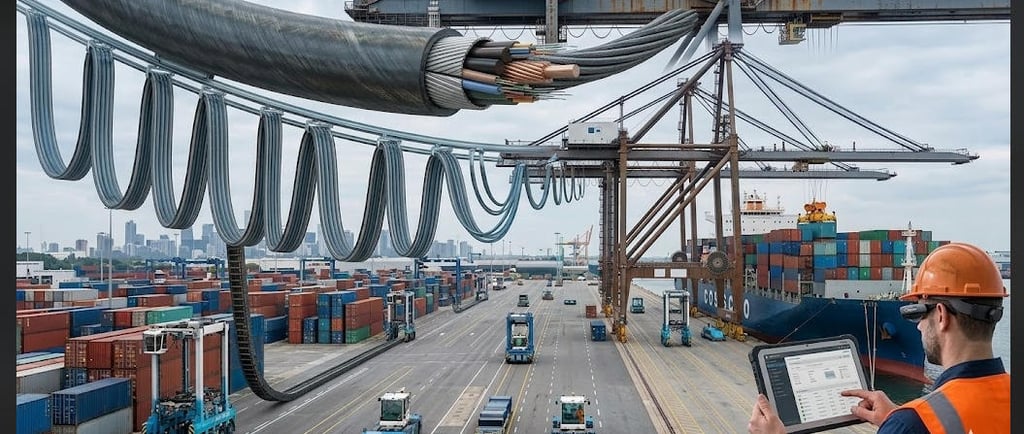
The maritime shipping and logistics industry is undergoing a monumental shift. To keep up with expanding global trade and the demand for faster vessel turnaround times, mega-ports worldwide are transitioning to full automation. Automated Stacking Cranes (ASCs), Ship-to-Shore (STS) cranes, and Automated Guided Vehicles (AGVs) are replacing manual operations.
However, automation introduces a distinct technical challenge: machinery now operates continuously ($24/7$) at much higher speeds and accelerations. At the heart of this automated revolution lies a critical, often overlooked component—the specialized power and data cables.
As a leading crane cable solution provider, we are closely monitoring these industry shifts to engineer the next generation of cables required to power the smart ports of tomorrow.
1. Higher Dynamics: The Need for Extreme Acceleration
In a traditional manual port, crane movements are subject to human reaction times and operational pacing. Automated cranes, however, operate on optimized algorithms designed for maximum speed and abrupt acceleration.
Standard cables simply cannot withstand the mechanical stress of these high-dynamic environments. Modern crane cable design must incorporate:
High-tensile strength center elements made of aramid fibers (such as Kevlar) to absorb sudden pulling forces.
Specially formulated compound jackets that prevent outer wear during continuous, rapid winding and unwinding on cable reels.
Without these design evolutions, cable fatigue would lead to frequent micro-cracks, unexpected downtime, and significant financial losses for terminal operators.
2. The Integration of Fiber Optics for Real-Time Data
Port automation relies entirely on data. Automated cranes require an uninterrupted flow of real-time information to communicate with the central Port Management System (PMS), utilizing sensors, cameras, and positioning systems.
Consequently, modern crane cable design is no longer just about transferring high-voltage electricity; it is about hybrid functionality. Leading edge designs integrate single-mode or multi-mode fiber optic bundles (FO) directly alongside power conductors.
As an experienced crane cable solution provider, we ensure these delicate fiber optic cores are strategically cushioned and twisted with a specific lay-length. This precise engineering prevents the optical fibers from stretching or breaking under the immense torsional stress of a heavy-duty crane reel.
3. Predictive Maintenance and Smart Cables
The future of smart ports lies in predictive maintenance—identifying a component failure before it happens. Cables are moving closer to this capability.
The next generation of crane cables features integrated diagnostic elements. These sacrificial internal wires or sensor layers actively monitor the physical wear, temperature, and torsional stress of the cable. When a cable approaches its operational limit, it automatically alerts the maintenance team.
By partnering with an innovative crane cable solution provider, terminal operators can transition from reactive, costly emergency repairs to planned, scheduled replacements during natural port downtime.
4. Sustainability and Environmental Resilience
Green port initiatives are pushing manufacturers to eliminate hazardous materials. Future cable designs prioritize eco-friendly, halogen-free, and recyclable materials without compromising on performance.
Furthermore, automated ports are expanding into harsher climates—from scorching desert coastlines to freezing Arctic terminals. Cables must be engineered with advanced PUR or specialized rubber compounds to remain perfectly flexible at -40℃ and UV-resistant up to +90℃.
Summary: Designing for the Next Decade
Port automation is not a passing trend; it is the definitive future of global logistics. As crane speeds increase and data requirements surge, standard legacy cables will rapidly become obsolete. The efficiency of a multi-million dollar automated terminal is ultimately bound by the reliability of its moving cables.
Choosing a generic supplier is no longer viable. You need a dedicated crane cable solution provider who possesses the engineering capability to custom-design hybrid, high-speed, and intelligent cabling systems tailored to the future of smart ports.
Ready to future-proof your terminal operations?
Contact our technical engineering team today to explore our advanced portfolio of automated crane cable solutions.