How to Fix Twisted & Tangled Elevator Cables: A Troubleshooting Guide
Is your elevator traveling cable twisting or tangling? Learn the step-by-step fix for cable distortion and discover how to prevent costly hoistway snags.
ELEVATOR CABLESCABLE BUYING GUIDES
6/15/20263 min read
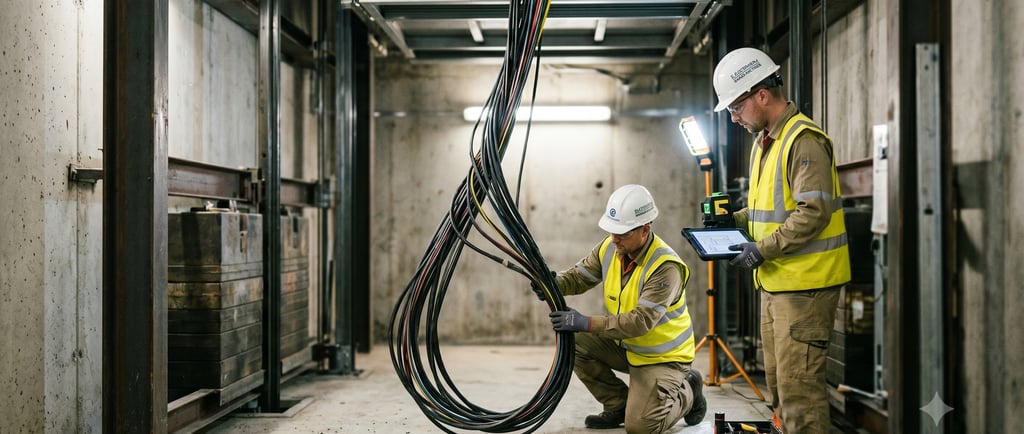
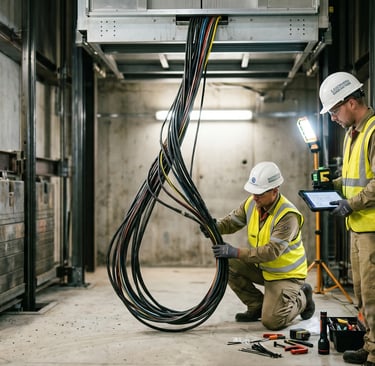
In the vertical transportation industry, a smooth ride is the ultimate measure of quality. However, behind the scenes, maintenance engineers often battle a frustrating and potentially dangerous phenomenon: twisted and tangled elevator cables (often referred to as "traveling cable twisting" or "dog-legging").
When an elevator traveling cable twists, it rubs against the shaft walls, catches on hoistway equipment, and suffers premature wear. In worst-case scenarios, a tangled cable can snag, causing catastrophic structural damage or sudden system shutdowns.
If you are dealing with cable distortion, this guide will walk you through how to diagnose, fix, and prevent twisting. Plus, we’ll explain why choosing the right elevator cable manufacturer is your best defense against this costly issue.
Why Do Elevator Cables Twist and Tangle?
Before jumping into the fix, it is vital to understand why this happens. Elevator cables don't just tangle randomly; twisting is almost always a result of improper installation, structural shifting, or manufacturing defects.
Torsional Stress During Installation: If a cable is pulled off its shipping spool incorrectly (e.g., uncoiled sideways rather than rolled off the reel), it introduces inherent twists into the cable copper cores.
Improper Hanging Alignment: If the hitch points on the elevator car and the hoistway wall are not perfectly aligned, the cable will operate under an asymmetrical angle, forcing it to twist as it loops.
High-Speed Aerodynamics: In modern high-rise buildings, high-speed elevators create massive wind pockets in the shaft. This aerodynamic turbulence can cause a poorly balanced cable to sway and eventually twist.
Subpar Manufacturing: Lower-grade cables lack internal structural balance. A premier elevator cable manufacturer designs cables with counter-directional layers to naturally neutralize internal torsional forces.
Step-by-Step: How to Fix a Twisted Elevator Cable
If you discover a cable is twisting or forming a "Kink," follow these industry-standard troubleshooting steps:
Step 1: Perform a Controlled "Hang-Out" (De-tensioning)
The most effective way to eliminate built-in torsional stress is to let gravity do the work.
Park the elevator car at the bottom of the hoistway.
Carefully disconnect the cable from the car-side hitch point.
Allow the cable to hang freely in the pit for 24 to 48 hours. This allows the internal copper strands and steel cores to naturally unwind and relax.
Step 2: Check and Re-align the Hitch Points
Alignment is everything. Use a plumb line or laser level to verify that the car hitch point and the wall hitch point are perfectly parallel. Even a few millimeters of misalignment can create a constant twisting force every time the elevator moves.
Step 3: Install Cable Guides or Sway Devices
For elevators operating in high-wind shafts or traveling at speeds over 2.5 m/s, manual straightening might not be enough. Consider installing:
Cable guiding devices (Sway rings): To restrict lateral movement.
Chain guides: If the traveling cable is paired with a compensating chain.
Prevention: The Ultimate Solution to Cable Twisting
While fixing a twisted cable minimizes immediate danger, the real solution lies in prevention. Repeatedly twisting and untwisting copper weakens the conductors, leading to internal micro-fractures and eventual electrical failure.
To permanently eliminate cable tangles, look at your source. Partnering with a specialized elevator cable manufacturer ensures that your cables are engineered to resist twisting from day one.
Feature Low-Cost Cables High-Performance Manufacturer Cables Internal DesignUnbalanced core layout Symmetrical, counter-twisted layers Support Elements Cheap textile or low-grade steelHigh-tensile aviation steel wire FlexibilityRigid, prone to memory retentionSpecially formulated, highly flexible PVC/PUR
High-performance manufacturers utilize a design technique called symmetrical cabling. By twisting internal conductors in alternating directions, the mechanical forces cancel each other out, ensuring the cable remains perfectly flat and stable throughout its millions of operational cycles.
Conclusion: Don't Let Poor Quality Twist Your Profits
Fixing a tangled elevator cable requires significant downtime, labor costs, and safety risks. The most cost-effective solution is to invest in high-quality, torsion-free cables engineered for your specific hoistway dimensions and speed.
As a trusted global elevator cable manufacturer, we rigorously test our traveling cables in specialized dynamic-flex towers to guarantee zero-twist performance. Protect your building’s infrastructure and ensure passenger safety by choosing cables built to stay straight.
Need Expert Assistance?
Are your elevator cables kinking, twisting, or wearing out too fast? Contact our engineering team today for a comprehensive consultation. Let us help you select the perfect, low-maintenance cable solution for your next project.