
How to Choose the Best Crane Cable for High-Load Tasks
Searching for the perfect cable to power your heavy-duty operations? This comprehensive guide by a leading crane cable manufacturer in China breaks down the essential factors for choosing the best crane cables for high-load tasks. From the flexibility of YFFB flat cables to the durability of rubber cable reels, learn how to enhance equipment lifespan and reduce maintenance costs through expert material selection and technical compliance.
CRANE & HOIST CABLESCABLE BUYING GUIDES
4/20/20262 min read
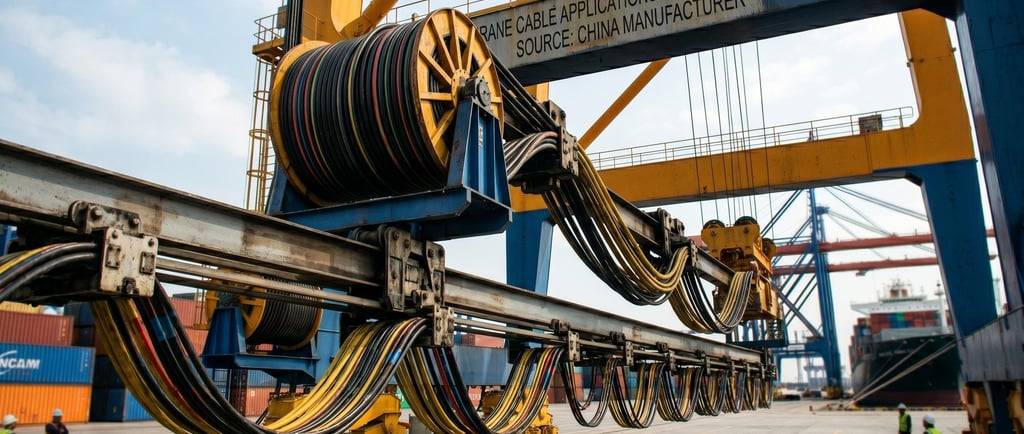
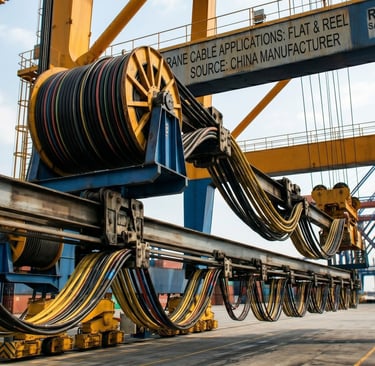
In the demanding world of heavy industry, the reliability of your equipment is only as strong as its weakest link. For cranes operating in ports, construction sites, and manufacturing plants, that "link" is often the cable. Selecting the wrong cable for high-load tasks doesn't just lead to downtime; it poses significant safety risks and inflates long-term operational costs.
As a professional crane cable manufacturer in China, we understand that high-load applications require more than just standard wiring. You need specialized engineering to withstand constant tension, bending, and environmental stress.
1. Understand Your Movement Dynamics
Before looking at specifications, define how the cable will move. Not all high-load tasks are the same:
Festoon Systems: Require high flexibility and resistance to "corkscrewing."
Cable Reels: Demand high tensile strength to handle the constant winding and unwinding under tension.
Drag Chains: Focus on abrasion resistance and a tight bend radius.
For high-load tasks, a flat cable like the YFFB series is often preferred for festooning because it prevents tangling and allows for smaller bending radii compared to round cables.
2. Prioritize Conductor Material and Stranding
For heavy-duty performance, the internal structure is king. Look for finely stranded oxygen-free copper conductors. The finer the stranding, the more flexible the cable remains under heavy mechanical loads. As a leading crane cable manufacturer in China, we utilize Class 5 or Class 6 flexible copper conductors to ensure that our cables can endure millions of bending cycles without internal fracturing.
3. Choose the Right Insulation and Jacket
High-load tasks often happen in harsh environments. Your choice of outer sheath material determines the cable's lifespan:
PVC (Polyvinyl Chloride): Suitable for standard indoor crane applications.
PUR (Polyurethane): Exceptional for high-abrasion, oil resistance, and low-temperature environments.
Rubber (Chloroprene): The gold standard for heavy-duty outdoor use, offering excellent weather and UV resistance.
4. Tensile Strength and Support Elements
When lifting heavy loads, the cable often supports its own weight plus the stress of rapid acceleration. Ensure your cable includes central strength members made of aramid fiber (Kevlar) or galvanized steel wire. These elements absorb the pulling force, protecting the copper conductors from stretching—a common cause of intermittent signal loss or power failure.
5. Verify International Certifications
When sourcing from a crane cable manufacturer in China, compliance with global standards is non-negotiable. Ensure the products meet:
CE Marking: For the European market.
UL/CSA: For North American projects.
RoHS: Ensuring environmental safety and material quality.
Buying factory-direct from a certified manufacturer ensures that you are getting "source-factory" pricing without compromising on these critical safety benchmarks.
6. Environmental Resistance
High-load cranes in ports must deal with salt spray and high humidity, while those in steel mills face extreme heat. Always specify if your cable needs to be:
Flame retardant.
UV-resistant for outdoor exposure.
Chemical-resistant for industrial processing zones.
Why Partner with a Chinese Manufacturer for Crane Cables?
The global supply chain has shifted, and choosing a crane cable manufacturer in China offers a strategic advantage. Modern Chinese factories now combine state-of-the-art German production technology with localized cost efficiencies. This allows for high-performance cables—like the YFFB or heavy-duty rubber cables—at a fraction of the cost of European competitors, without sacrificing technical integrity.
Conclusion
Choosing the best crane cable for high-load tasks requires a balance of mechanical durability, electrical efficiency, and environmental resistance. By focusing on the movement type, conductor quality, and specialized jacketing, you can significantly reduce maintenance intervals.
Looking for a reliable crane cable solution? As a dedicated crane cable manufacturer in China, we provide factory-direct pricing on premium YFFB, PUR, and rubber cables tailored for your specific project needs. Contact our engineering team today for a technical datasheet or a custom quote!