
Heavy-Duty Crane Cables for Port and Maritime Operations: The Ultimate Reliability Guide
Discover why ports and maritime operations require heavy-duty crane cables. As a professional crane cable solution provider, we provide an in-depth analysis of how corrosion-resistant, high-tensile-strength cables can reduce downtime and improve terminal efficiency. Click to read our expert selection recommendations.
CRANE & HOIST CABLESCABLE BUYING GUIDES
4/14/20262 min read
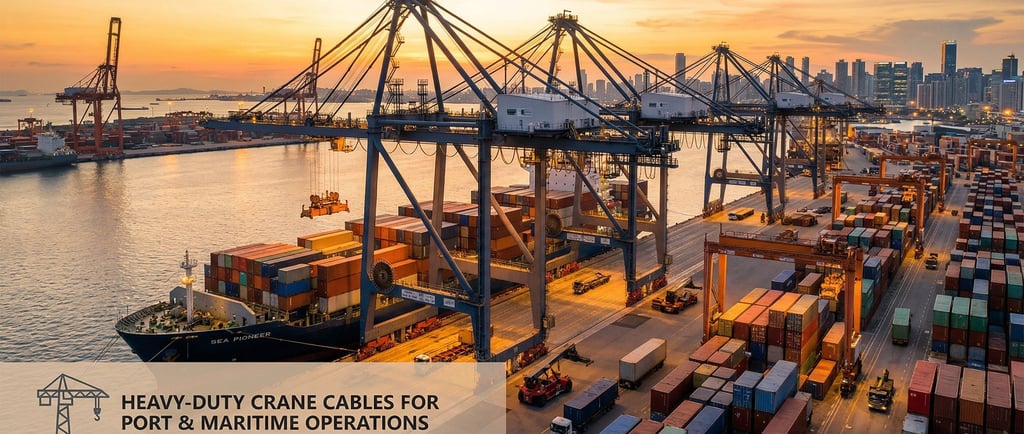
In the fast-paced world of maritime logistics, downtime is the enemy of profitability. Port authorities and terminal operators rely on seamless automation to move thousands of containers daily. At the heart of this synchronized dance lie heavy-duty crane cables—the unsung heroes that power ship-to-shore (STS) cranes, yard cranes, and stackers.
As a leading crane cable solution provider, we understand that maritime environments present some of the harshest conditions on Earth. In this blog, we’ll explore why specialized cabling is critical for port operations and what features you should prioritize for maximum service life.
The Brutal Challenges of Maritime Environments
Standard industrial cables often fail within months when exposed to the sea. To ensure continuous operation, crane cables must be engineered to withstand:
Salt Spray and Corrosion: High salinity leads to rapid oxidation of inferior conductors and jackets.
UV Radiation: Constant exposure to direct sunlight can cause standard PVC jackets to crack and become brittle.
Extreme Mechanical Stress: Reeling and festoon systems subject cables to constant tension, bending, and high-speed acceleration.
Temperature Fluctuations: From freezing winter nights to scorching summer days, cables must remain flexible and functional.
Key Features of High-Performance Maritime Crane Cables
To navigate these challenges, a professional crane cable solution provider focuses on several high-tech specifications:
1. Advanced Jacket Materials (PUR vs. Special Compounds)
For maritime use, Polyurethane (PUR) or specialized rubber compounds are preferred. These materials offer superior resistance to oil, chemicals, and seawater while maintaining extreme flexibility at low temperatures.
2. High Torsional and Tensile Strength
Crane cables in ports often experience "corkscrewing" if not designed correctly. We utilize integrated anti-torsion braids (typically high-strength aramid or textile) to ensure the cable remains stable even under intense mechanical load.
3. Optimized Bending Radii
In container terminals, space is a luxury. Cables designed with a small bending radius allow for more compact festoon systems and reeling drums without compromising the internal copper cores.
Why Partner with a Specialized Crane Cable Solution Provider?
Choosing a generic cable supplier might save costs upfront, but the long-term risks are substantial. A dedicated crane cable solution provider brings more than just a product; they provide engineering expertise.
Customization: No two ports are identical. Whether you need integrated fiber optics for real-time data transmission or specific shielding for EMI protection, custom-engineered solutions are vital.
Factory-Direct Quality Control: By working directly with a manufacturer, you ensure that every meter of cable has undergone rigorous testing—from salt spray chambers to millions of continuous bending cycles in the lab.
Technical Support: From calculating the tension on a reeling drum to advising on the best cable for a specific spreader, expert guidance reduces the risk of premature cable failure.
Maintenance Tips for Extending Cable Life
Even the most durable heavy-duty crane cables require proper care. As your crane cable solution provider, we recommend the following:
Regular Inspections: Check for jacket abrasions or "bird-caging" (uneven twisting) every quarter.
Correct Installation: Ensure that cables are not twisted during the initial winding process on reeling drums.
Lubrication: For certain types of outdoor cables, keeping the external surfaces clean of grit and salt buildup can prevent friction damage.
Conclusion: Powering the Future of Global Trade
The efficiency of a port is only as strong as its weakest link. In an era where "Smart Ports" and automation are becoming the standard, investing in high-quality, heavy-duty crane cables is not an option—it’s a necessity.
Are you looking for a reliable partner to power your maritime operations? As a professional crane cable solution provider, we specialize in high-flex, durable cabling designed to thrive in the world’s toughest ports.